Wednesday, 10 December 2014

In which Cate blogs for Special Collections and talks to a real live Pease person

The main news of the week is that my Special Collections blog post about the Gott archive has gone live:

http://blog.library.leeds.ac.uk/blog/special-collections

My manager edited it here and there but the general info is there.  She then, unexpectedly, sent an e-mail telling everybody that it had been posted.  I felt quite awkward about this at first, but then had four people either send me a message or come up to me saying they liked it, or, in the case of one of them who is a Geordie, ‘it was good like’.  Another of these people was the archive manager who oversees the work of my manager and myself.  It meant a lot to me that she is happy with what I've been doing.  Everyone in Special Collections is so nice it's like you're living in Niceville.  I can't think about anyone there without going ‘Awwww, they're so nice’.  I think how lucky I am every day I'm there.
 
I also think about the time my sister bought me the Mr Man book ‘Mr Quiet’ as a joke.  Mr Quiet was fed up because everything around him was too loud – he resolved this by moving to Happyland and working in a library!  Little did I know that this text would be eerily prophetic.

Oh – and they want me to write to more blog posts!  One in January and another summing things up at the end of my internship. 

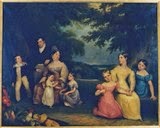
In other news: you may remember that I've been fascinated by a black-and-white photograph of a Victorian portrait of the Pease family of Chapel Allerton. 

I took a two-week free trial of the genealogy site ancestry.co.uk, which helps you build your family tree but also hosts a community of family historians who help each other out. Partly I just wanted to see how it worked, but my main intention was to look at the Pease family tree. Names were repeated over and over again in their family, so there were about five Thomas Peases and it was confusing the hell out of me. After printing out some branches of trees with the info I wanted, I sent a message to the person who'd uploaded the colour picture of the portrait, Sarah, asking her if she knew where the original was.  She turned out to be a contemporary member of the Pease family (I don't know the exact relationship because Ancestry doesn't show names of people who are still living). She was quite happy to answer my query.  

Apparently, the real painting is with a family member so, as I suspected, I won't be able to go and see it, but Sarah gave me some very interesting information: the picture was passed down to Thomas Pease, the young boy in the painting, but he never hung it in his house.  This was all because of Jane Pease, the baby in this picture.  You remember I mentioned her before as having been in and out of institutions, although I did go back and change that post, because it seems it wasn't through mental health issues but from being what Marion Pease calls ‘mentally deficient’ (so obviously a mental disability or learning difficulties). Thomas Pease was afraid that this condition could be inherited, and he was so determined not to worry his wife and children about it that he kept Jane's existence a secret from them. Sarah says that, for years Marian Pease never knew that she had an Aunt Jane. We don't know when she finally found out. As somebody interested in the medical humanities and approaches to disability, I’m really intrigued by this story. I really wish I knew what kind of life Jane Pease had. Her behaviour must have really disturbed her brother – or was it just the attitudes of the time that made him feel the way he did? 

In return for helping me, I sent Sarah a list of the portraits we have at the Brotherton so she could see if there were any she could add to the images in her family tree. There is one she wants, and actually it’s one that I’m hopefully going to digitise after Christmas, so if it ends up going online, she’ll be able to see it. Maybe, once it’s available to the public, I’ll be able to take a photo of it if she can’t use the image on the screen (or come to Leeds to see it herself!). This has all brought home to me how important family archives are – we are dealing in real people’s lives. Although we’re not a local history archive as such, this is an example of how today’s generations can use the Brotherton’s collections to get a true sense of what life was like for their remarkable ancestors.

Saturday, 29 November 2014

Archival Film Adventures!

Since I’m planning to apply as soon as possible to do a postgraduate diploma, I thought I’d do some activities that will help me research areas of archiving I’m unfamiliar with and generally expand my awareness. Some time ago, I sent an e-mail to the Yorkshire Film Archive, in York St John University, asking if I could visit, and was delighted when the manager, Graham, offered to take me round himself. As a film fan, I really wanted to learn more about film and sound archiving, and the fantastic morning I spent at the YFA last Friday did not disappoint.

http://www.yorkshirefilmarchive.com/

The archive is situated in the corner of a library on the university campus. After a welcome, I was first taken round their three main storerooms. The archive will accept film or video from anyone at all who wants to donate, provided that it’s about Yorkshire or featuring Yorkshire people and generally useful to them – so the first room is full of people’s donations that are waiting to be accessioned. Graham showed me some of the reels of tape, which had come to them in various containers such as toffee tins and tupperwares. You could tell most of them had been dug out of people’s attics! They are all held in this room until someone is able to check them and assess what’s on them and their usefulness. If considered appropriate, the film strip is then transferred to a standardised reel, labelled with an accession number and brief description then moved to the next storeroom.
These rooms were really quite cold – definitely a lower temperature than our stacks at the Brotherton. This is because old film is in great danger of deteriorating. Graham showed me an example of some acetate film that was in quite a bad state – the most obvious sign being that it smelt of vinegar! I had meant to ask him if they had ever got anything in that was on the nitrate film stock that can explode like in Cinema Paradiso. I never did though.
Then I was taken to the room in which is stored the film that has been transferred to digital tape for use by the archive. This is incredibly expensive to do and so is only carried out on demand, for specific projects: research, television, exhibitions and so on. In fact, the whole archive is very expensive to maintain, considering all the specialist equipment, labour time, and the need to keep those cold temperatures consistent, but they get funding from various sources. Sadly, we also have to consider that technology moves on, and the equipment used to play this tape will one day be obsolete, meaning, presumably, another transfer to a different format and more expense.
Graham told me quite a funny example of a recent user of the archive: the band Metallica. They had wanted to show some film footage of fox hunting during their Glastonbury set; it was meant to be a joke because of the big controversy over their singer’s support of hunting. I think I’d feel uncomfortable helping them out with something like that, but I guess you can’t pick and choose these things!
Next we went and talked to Steve, who works with the film itself. He views people’s donations when they come in and assesses whether they are unusual or interesting enough to be kept, making sure that they’re relevant. He also writes catalogue records for the film. When I’d read some of these online, I’d been surprised that each one featured a quite detailed descriptions of what went on in the film. I felt this must be time-consuming, but I was told it was important so that researchers or in fact the archive themselves can find specific parts of the film that are of interest, or can cross-reference when doing a search. Steve was viewing a new film when I came in, on a huge reel-to-reel machine, a lot more hi-tech than the cine-film projector in my dad’s loft! Like many, I expect, the film seemed to feature a family holiday. He said they get as much information as they can from the owner regarding what exactly is happening in the film, but still it’s very often difficult for them to ascertain what’s going on!
Finally, I went into the room where film is cleaned and repaired – again using special equipment including quite a large cleaning machine, as well as solvents and so on. The best part, though, came when I was shown some of the actual films the archive themselves were producing from pieces of footage. I had no idea they did this themselves but apparently an editor comes in every week. I saw a short extract from ‘Filmed but Not Forgotten’, their current, Heritage Lottery-funded project for the WWI centenary. They have taken all the films they have from around this time – obviously not a huge number – and remastered them so they are available for the public to view. They’re also running a campaign to try and identify some of the filmmakers and the people who are in the films.  http://www.yorkshirefilmarchive.com/videos/filmed-and-not-forgotten  . Interestingly, the Brotherton will be helping them out with this by digitising a programme for Ripon Sports Day from 1916.
The other two films I saw were ‘Trike to Bike’, a lovely 5-minute film they made for the Tour de France, which you can see here: http://www.yorkshirefilmarchive.com/content/le-tour-comes-yorkshire  and, excitingly, an unfinished version of the trailer they’re making for Hull, City of Culture  – more info about this is here http://www.yorkshirefilmarchive.com/content/film-search-hull . Everyone who might have a film about Hull is being encouraged to search their attics, as they really want to expand this particular film collection in time for 2017.
The edited films I saw were of an excellent quality. I was really inspired, but also moved to think that so much of this footage was recorded by ordinary members of the public, in their back gardens, or perhaps out at a community event. Now their images will be preserved as long as the archive lasts, going on into the future to educate and enchant anyone who views them in the years to come. Without even knowing it, these people have made their mark on history.
I left the archive on a real high – I’d love to work somewhere like this some day. The staff were really nice and I’m so appreciative of Graham for giving up his time to show me round. To anyone out there who have a film to donate, or just want to find out more about what YFA does, I’d very much recommend it.

Thursday, 20 November 2014

Gott some news, Pease take note! (Ok, enough with the puns now)

Well, today I’m not quite sure where to begin… I had a pretty exciting time in the art store last Thursday because I found a whole bunch of artworks from the Mrs. Frank Gott collection. Frank Gott was Lord Mayor of Leeds from 1917-18 and Beryl Gott the Lady Mayoress. She was also Leeds’ first woman alderman and one of the city’s first female magistrates. The Gotts, like the Ford family, began as wool merchants – Leeds is largely built on the textile and wool industries so generally big on cloth.


If this webpage is anything to go by, it seems Mrs Gott bequeathed things all over the place and the Brotherton library is no exception. We have the couple’s papers and very many artworks, mostly drawings and prints. A lot of these depict scenes of Leeds or old plans – here’s one:
 
 
These are either in the store or displayed around the library but (fun times for me) not all of them have records. The notes left by a previous art gallery collections manager indicated that there were a few Gott Bequest things around – she even left some images – but I just couldn’t account for all of them. Then I had the brainwave that, instead of doing any more fruitless searches on the database, why didn’t I just LOOK AROUND?!! I can tell this will be an important lesson in my archiving career. In a few minutes I’d found several prints that I’d been searching for, which means I can start to make records for them. Then (taking the ‘look around’ idea to a new level) I glanced slightly to the right just before entering Special Collections to return the store key and saw two more Gott pictures on the wall! How many hundreds of times had I walked past those?!
Well, I’ll try and contain my excitement and not write any more about that because when I told my manager about it at my 1-to-1 she said she wanted me to write a blog post for Special Collections about all this because I could ‘get some emotion into it’! I can’t remember past blog posts of theirs being especially emotional but I’ve told her I’ll do my best. So I’m going to be blogging for the Special Collections website! Obvs will post a link when it’s live.
I also asked if there were any chance I could take photos for my own blog and she said I potentially could do a couple, but I don’t think I’ll be doing many if at all unfortunately. As well as anything else, there’s something I hadn’t thought of – issues around copyright. You can’t publish something that is inside copyright without permission, and the rule generally is that the writer or artist has to have been dead for 70 years. From what I gather, it seems that this includes reproduction of images. So the portraits might be a possibility but the Edith Culman collages would be out. I’m sure people take photos of people’s art and stick it on the net all the time but apparently you can’t do this officially. Anything we digitise and put on our website also has to be within copyright. It’s been suggested that I might even be able to write some letters requesting permission at some point; watch this space!
More finds followed while in work yesterday… For no reason whatsoever, while in the stacks I went and had a look at the Cottingley Fairies collection, but that’s for another time! I then went and deframed the Pease Family Portrait and got a huge surprise. When I’d removed the frame, underneath was a small stretcher with quite a large pencil drawing of a young girl on it. It was inscribed ‘Cara, 1921’. Why had Marian Pease covered up this lovely drawing with a photograph of a portrait? A possible answer emerged when I took the stretcher down to show the conservator. She looked at it closely and pointed out that it was not an entirely genuine pencil drawing, but a print that someone had added to in pencil. Maybe this was why it hadn’t been deemed worth displaying – it wasn’t a ‘proper’ drawing. Meanwhile, the back of the stretcher had been padded with a Radio Times from 1941 – interesting in itself! I pictured the scene: it’s wartime and Marian Pease doesn’t want to spend money on frames, so she takes this picture of a family member, one she’s not particularly fond of but doesn’t want to throw away, puts the photograph of her father’s family over the top, stuffs it with this week’s Radio Times and puts a simple frame around the whole thing.
And who is Cara? It’s Margaret Cara Benson Rablen, who, along with her sister, bequeathed the Ford family portraits collection. She was born in 1914, died in 2011 (you can see her obituaries on Leicester Quaker sites) and is the great-granddaughter of Hannah Pease. Much to impress my manager with for next time, ha ha! 

Wednesday, 12 November 2014

A collage education

I had a pretty good two days’ work last week. It was all very quiet, because everyone was helping the conservator do a survey of hundreds of old books that are to be moved to the store on the Western campus, to assess what protection they would need. You had to go over them on their shelves in the stacks and identify which books needed tying round with cream tape, or putting in paper wrappers or envelopes.  I had come in earlier in the week to help, so I focused on getting through the objects that was still to survey in the L-shaped room. On Wednesday I scanned Marian Pease's letter onto the Pease family portrait record (I seem to be getting the hang of doing this now). I also worked out how to use the Special Collections camera, despite never having owned a camera since childhood and certainly not a digital one! I photographed a couple of long Victorian labels, including the one on the back of Christopher Rawlinson, so now I don't have to copy down all that Latin.  I transferred the photos to the computer, ready to attach to their records next week.

So I was already feeling quite pleased with myself, then the big boss came in and I hopefully managed to impress her by telling her that I'd found out the provenance of the portraits (meaning what collection they come from) and of the 70s mixed media collages.  Then I went for lunch to the Pickards letting agents cafĂ© (yes really) opposite the uni, and they played Lykke Li the whole time.  So I was in a pretty good mood that day. 

There are several collages, all made by a woman called Edith Culman, who died in 2004. They are mostly from the late 60s and early 70s and believe me they look it – no skimping on the hessian and brown corduroy. Some are made entirely of fabric, others from materials as diverse as string, straw, wood, painted paper, egg cartons, peach stones and, very weirdly, a lamp that seems to have come from a camera flash. None of them seem to represent anything in particular and are just swirly lines and chaos; in fact it takes some working out which way up they go, which makes measuring awkward.  I remarked to myself while looking at the first one that I had no idea what this curly shape was meant to be – then had to laugh when I saw that the title was ‘Pas un Escargot’, or ‘not a snail’ – that narrows it down anyway!

However, just as I was wondering why on earth we had these things in the first place, I discovered, with some help from staff, that they came from the Holocaust Survivors Friendship Association’s collection, which comprises interviews, correspondence and personal effects of survivors who came to Yorkshire to make a new life.  http://holocaustlearning.org/  I could then see how these collages might help a historian or art student reflect on the lives of such survivors, and how, perhaps, I would only get a rounded picture of what inspired Culman by looking at the rest of the collection in the stacks.  I also noticed that one, extremely disordered collage had a note on the reverse that said ‘Untitled piece: Parkinson's phase’. This object is mounted on MDF, instead of on hessian cloth like Culman's earlier work. I wondered if the artist's Parkinson's disease had made a change of materials and style necessary or if it was a personal choice, or even if this art somehow expressed her symptoms and emotions. I have found a handlist (separate list made by us) for the collection and do intend, when I can, to look at some of Culman’s letters, especially those between her and other survivors across the world, because I think that sounds really interesting.
 
I have tried to find pictures of the collages online, but can find nothing like them!  I'm not sure anything like them exists anyway, well not since the 70s.  I've decided to bite the bullet and ask my manager at our next meeting whether I definitely can't take photos of artworks for my blog.  Probably can't but worth asking.  If I can, I'll add some, if not then I guess I will just have to try and replicate one of the collages myself.  Off to the supermarket for eggs and peaches then…

Friday, 31 October 2014

The Pease-Ford dynasty

I thought that this time I might give an example of a particular collection I’m working on. It’s been difficult to connect artworks with a collection, especially in the store, as so often, not everything is listed in the collection’s record in EMu – or, if it is, it might say ‘artworks’ without being any more specific. However, I’m pleased to say that I did find evidence in the database of exactly where my group of portraits in the L-shaped room has come from. This was made easier by the fact that the portraits (and some other art) are the only items in this particular collection, so everything was listed nicely and to order.

The University has a very large Quaker collection, and these portraits relate to the Ford family, a wealthy Quaker family of the Victorian era. They intermarried with the Leeds branch of the Pease family, prominent industrialists in the wool trade. The Leeds Peases are here on Wikipedia, under ‘more distant relations’.  http://en.wikipedia.org/wiki/Pease_family
Once I found the list for the collection in EMu, I started to piece together exactly who these people were and the important part they played in Leeds' history, and have been researching where I can ever since. Here is the entire list, with my notes on it - you'll have to zoom in, and apologies to anyone colour blind! The objects I’ve found are in red and my additions are in purple. Incidentally, when I was volunteering, one of my tasks was to write lists like this!


The object that has most intrigued me is the family portrait (xi) –  actually the ‘Pease Family Portrait’. We have a black-and-white photograph of this, with a letter attached written by Marian Pease, the daughter of the young boy in the photograph, Thomas Pease. (Marian is mentioned on the Wikipedia page as an ‘educator’, though I don’t know in what capacity.) This letter names everyone in the portrait and details some of Marian and her father’s memories of the Pease sisters. I am now dying to find out where the original is. Even if it’s in a private collection, I just want to know! An image of it has been contributed on ancestry.co.uk and I have decided to become a paying member just so I can look up the Pease and Ford family tree and try and trace the portrait! Until then, only my line manager can log me in, so this image of the portrait is small (as it’s taken from a thumbnail). I’ll replace it when I can.

The oldest sister, Hannah Ford nee Pease,


was the mother of Isabella Ford, the social reformer, and Emily Ford, the artist, two amazing women I can’t believe I’ve only just discovered now. Read about them here:
However, I feel a lot of sympathy for the youngest daughter in the portrait, Jane. 
She is described as 'mentally deficient' and was institutionalised at various times during her life.
Apparently the Fords of Adel were a radical family who supported societal reform – very unusual for their class. They also believed in gender equality: definitely my kind of people!
The other portrait that really interests me is an older, early 18th century print of Christopher Rawlinson, a descendant of the Fords. He was an aristocrat from Essex who went to live at Cark Hall in Lancashire and spent his days editing Anglo-Saxon texts.
The National Gallery holds more of the same print; here is the image from their website:


Unfortunately, the one we have is the picture I referred to last time, that has been eaten away by silverfish! If you can imagine, those nasty critters have left all the black parts (as they don’t like eating ink) and have taken big patches out of the white parts, namely his face. He looks like he has had a bad case of peeling after sunburn.
On the back of the frame is a label with some manuscript in Latin; I had to go and ask the two people in the office who were fluent in Latin to help me decipher it, except that it confused them as well. Eventually I found out that the text was taken from the frontispiece of Rawlinson’s book.
It’s so interesting researching these people – I just have to make sure it doesn’t distract me too much from doing my surveys!

Tuesday, 21 October 2014

Creepy crawly alert!

I forgot to mention in the post about conservation that occasionally you also see some insect damage. I had to check for bugs quite a lot as a volunteer – my seminal moment was finding a ‘book louse’, as identified by the conservator. She takes bugs very seriously; any sign of them gets the infected item or box a sentence of two weeks’ quarantine. Another option is freezing, if the item is made of suitable material. Usually, though, what looks like some kind of sinister, paper-chomping insect turns out to be a squashed, dead spider.

Silverfish can be a problem in archives; it's hard to spot them or get rid of them in rooms piled high with old things.  Although they may seem relatively innocuous when whizzing round your bathtub, in fact they are little horrors if they get out of hand.  Before I started, I had no idea that silverfish ate paper, but in fact, because their diet is of starch and sugar (pretty much like mine really), they enjoy eating wood, paper or carpet (OK, not like me). For us this means they can damage any paper item including drawings, prints or photos. The example I was shown was a portrait from which the person’s face had pretty much disappeared because the bugs had taken the surface off the paper; I couldn’t find a similar picture to this to show you but here is a map and its frame that have had a bit of a chomping (all pics from Creative Commons of course):


Something else I've come up against is woodworm holes.  The woodworm (and I’ve only recently learned this interesting fact) isn’t actually a species in its own right, that’s just a term we use to describe damage made by the larvae of wood-boring beetles. I very often find holes on the stretchers of old paintings, but the worst case I've seen was on a wooden cover of a book from the Brotherton Collection’s Incunabula (or printed, pre-sixteenth century books to you and me).  A staff member showed me this during a talk and it was absolutely peppered with holes.
I find it very hard to ascertain how old the holes are; someone told me you can consider how clean-looking they are, but they mostly look the same to me!  You also have to consider the insect’s life cycle and that generally only in the summer months will the adult beetles emerge and cause havoc. Here is what the holes look like, though the ones I've seen are smaller than this.


We did find an object recently that had wormholes that looked slightly suspect.  It is a mysterious painting in oil wash, artist unknown and titled ‘Massacre of the Innocents’!  In one regard, it's one of my favourite objects, but as it depicts Roman soldiers pillaging a small town and killing its inhabitants, maybe it shouldn't be.  Anyway, gallery staff wrapped it up in plastic and have kept it off the rack, though it's winter anyway so the pests won't be too dangerous.  It's just a precaution and I'll leave it with them as to how long to keep it like that.  I can still examine it, I just need to keep wrapping it up again!
I hope you’ve enjoyed this post, because to research it and find images I’ve had to trawl through horrid blown-up pictures of bugs – yuk. Someone has put a sticky trap in the corner near where I work – it’s a really useful way of finding out what insects have been around, but is mainly full of huge spiders and is right next to my chair! Still, it comes with the territory…

Monday, 6 October 2014

Those pesky life decisions!

Well, things seem to be going pretty well for me at the Brotherton archives. I had a meeting with my manager to 'discuss the first stage of my probation' (uuurk!). Thankfully this was not as scary as it sounds; it was just to see if I'd achieved my objectives so far, which, apparently, I had. Learning to use the digitisation suite will come later, probably in January, when I've got more of the survey under my belt. I suggested that, sometime soon, I could learn to upload photos to EMu, as a better way of dealing with the elaborate labels the late Victorians so enjoyed sticking on things. For example, on one picture, by William Gosse (from the family of Philip Henry Gosse), the artist explains in detail the origins of the work, then digresses to point out huffily that he actually made another sketch of the same subject that was effectively stolen by an aquaintance, who gave it to 'some friend of his', who then exhibited it without asking permission! Yep, it's a big label. And in archiving, you generally try and copy anything written on anything into a record, or where it won't get lost, which means I had to type out the whole of Gosse's lament. Another painting is by an Italian artist and includes a long label written completely in Italian, which I gave up trying to copy out in full, or indeed translate! Luckily, my manager agreed that photos were a good idea.

Learning that I'm doing well in the job has also added to my growing conviction that I would like to follow archiving as a career. When first starting my internship, despite having done a lot of volunteering, I was unsure, preferring to keep my options open, but now I've had the chance to take on more responsibility, I can see that this could be my vocation. I feel at home in this working environment; in fact, for the first time, I feel part of a group of people who are actually like me (sounds terrifying to you, I know!). There are a lot of introverts and quiet people, and everyone gets satisfaction from putting things in order! They tend to be meticulous and fastidious and, I think, put effort into keeping things running smoothly. They also aspire to help others through their work in the public sector. Generally, then, they seem to share my kind of attitudes and values. Here I can put my skills to use and feel a part of something bigger that is going to make a difference to academic research in the years to come. This isn't to say that I'd definitely wind up with a job in a similar environment, and there are issues as with any vocation (for example competition in the job market, especially where permanent contracts are concerned). However, I feel enthusiastic about continuing on from here, and that's what's important.

Therefore, I'm trying to ascertain whether I will have enough experience to apply to do my postgraduate diploma in a year's time. I've booked a careers appointment to discuss options, and am looking at ways I can fill in any gaps in my knowledge. I've applied to join the Archives and Records Association as a full member (now that I'm technically 'working in the profession'!). I've had an e-mail saying that they've received my application and someone will get back to me; let's hope it won't be with a test or some kind of Herculean challenge! I imagine, though, that they'll be happy for me to join, and when I do I can try and attend some events and learn more about the role of the archivist in the wider world, and the latest developments.

According to ARA's complex website at  http://www.archives.org.uk/ , they seem to offer many and varied services. One really great thing is that you can join online groups according to your particular interests - I've requested to join those for digital archiving, conservation, film heritage and, essential to me, new professionals and students. I also found this fab blog, affiliated to the new professionals section, called 'Off the Record'  http://aranewprofessionals.wordpress.com/ . There are so many interesting articles on here I don't know where to start, but doubtless I'll find all the advice helpful, including that on how people got started in archiving.

I'll start to try and put some images on here soon - I'm not sure the staff would approve of my waltzing around taking pics and putting them online but I'll see if I can show you or direct you to some examples from collections I'm talking about - or, if you're lucky, something with alligatoring or silverfish damage :o)