Friday, 31 October 2014

The Pease-Ford dynasty

I thought that this time I might give an example of a particular collection I’m working on. It’s been difficult to connect artworks with a collection, especially in the store, as so often, not everything is listed in the collection’s record in EMu – or, if it is, it might say ‘artworks’ without being any more specific. However, I’m pleased to say that I did find evidence in the database of exactly where my group of portraits in the L-shaped room has come from. This was made easier by the fact that the portraits (and some other art) are the only items in this particular collection, so everything was listed nicely and to order.

The University has a very large Quaker collection, and these portraits relate to the Ford family, a wealthy Quaker family of the Victorian era. They intermarried with the Leeds branch of the Pease family, prominent industrialists in the wool trade. The Leeds Peases are here on Wikipedia, under ‘more distant relations’.  http://en.wikipedia.org/wiki/Pease_family
Once I found the list for the collection in EMu, I started to piece together exactly who these people were and the important part they played in Leeds' history, and have been researching where I can ever since. Here is the entire list, with my notes on it - you'll have to zoom in, and apologies to anyone colour blind! The objects I’ve found are in red and my additions are in purple. Incidentally, when I was volunteering, one of my tasks was to write lists like this!


The object that has most intrigued me is the family portrait (xi) –  actually the ‘Pease Family Portrait’. We have a black-and-white photograph of this, with a letter attached written by Marian Pease, the daughter of the young boy in the photograph, Thomas Pease. (Marian is mentioned on the Wikipedia page as an ‘educator’, though I don’t know in what capacity.) This letter names everyone in the portrait and details some of Marian and her father’s memories of the Pease sisters. I am now dying to find out where the original is. Even if it’s in a private collection, I just want to know! An image of it has been contributed on ancestry.co.uk and I have decided to become a paying member just so I can look up the Pease and Ford family tree and try and trace the portrait! Until then, only my line manager can log me in, so this image of the portrait is small (as it’s taken from a thumbnail). I’ll replace it when I can.
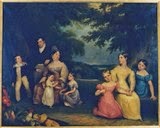
The oldest sister, Hannah Ford nee Pease,


was the mother of Isabella Ford, the social reformer, and Emily Ford, the artist, two amazing women I can’t believe I’ve only just discovered now. Read about them here:
However, I feel a lot of sympathy for the youngest daughter in the portrait, Jane. 
She is described as 'mentally deficient' and was institutionalised at various times during her life.
Apparently the Fords of Adel were a radical family who supported societal reform – very unusual for their class. They also believed in gender equality: definitely my kind of people!
The other portrait that really interests me is an older, early 18th century print of Christopher Rawlinson, a descendant of the Fords. He was an aristocrat from Essex who went to live at Cark Hall in Lancashire and spent his days editing Anglo-Saxon texts.
The National Gallery holds more of the same print; here is the image from their website:


Unfortunately, the one we have is the picture I referred to last time, that has been eaten away by silverfish! If you can imagine, those nasty critters have left all the black parts (as they don’t like eating ink) and have taken big patches out of the white parts, namely his face. He looks like he has had a bad case of peeling after sunburn.
On the back of the frame is a label with some manuscript in Latin; I had to go and ask the two people in the office who were fluent in Latin to help me decipher it, except that it confused them as well. Eventually I found out that the text was taken from the frontispiece of Rawlinson’s book.
It’s so interesting researching these people – I just have to make sure it doesn’t distract me too much from doing my surveys!

Tuesday, 21 October 2014

Creepy crawly alert!

I forgot to mention in the post about conservation that occasionally you also see some insect damage. I had to check for bugs quite a lot as a volunteer – my seminal moment was finding a ‘book louse’, as identified by the conservator. She takes bugs very seriously; any sign of them gets the infected item or box a sentence of two weeks’ quarantine. Another option is freezing, if the item is made of suitable material. Usually, though, what looks like some kind of sinister, paper-chomping insect turns out to be a squashed, dead spider.

Silverfish can be a problem in archives; it's hard to spot them or get rid of them in rooms piled high with old things.  Although they may seem relatively innocuous when whizzing round your bathtub, in fact they are little horrors if they get out of hand.  Before I started, I had no idea that silverfish ate paper, but in fact, because their diet is of starch and sugar (pretty much like mine really), they enjoy eating wood, paper or carpet (OK, not like me). For us this means they can damage any paper item including drawings, prints or photos. The example I was shown was a portrait from which the person’s face had pretty much disappeared because the bugs had taken the surface off the paper; I couldn’t find a similar picture to this to show you but here is a map and its frame that have had a bit of a chomping (all pics from Creative Commons of course):


Something else I've come up against is woodworm holes.  The woodworm (and I’ve only recently learned this interesting fact) isn’t actually a species in its own right, that’s just a term we use to describe damage made by the larvae of wood-boring beetles. I very often find holes on the stretchers of old paintings, but the worst case I've seen was on a wooden cover of a book from the Brotherton Collection’s Incunabula (or printed, pre-sixteenth century books to you and me).  A staff member showed me this during a talk and it was absolutely peppered with holes.
I find it very hard to ascertain how old the holes are; someone told me you can consider how clean-looking they are, but they mostly look the same to me!  You also have to consider the insect’s life cycle and that generally only in the summer months will the adult beetles emerge and cause havoc. Here is what the holes look like, though the ones I've seen are smaller than this.


We did find an object recently that had wormholes that looked slightly suspect.  It is a mysterious painting in oil wash, artist unknown and titled ‘Massacre of the Innocents’!  In one regard, it's one of my favourite objects, but as it depicts Roman soldiers pillaging a small town and killing its inhabitants, maybe it shouldn't be.  Anyway, gallery staff wrapped it up in plastic and have kept it off the rack, though it's winter anyway so the pests won't be too dangerous.  It's just a precaution and I'll leave it with them as to how long to keep it like that.  I can still examine it, I just need to keep wrapping it up again!
I hope you’ve enjoyed this post, because to research it and find images I’ve had to trawl through horrid blown-up pictures of bugs – yuk. Someone has put a sticky trap in the corner near where I work – it’s a really useful way of finding out what insects have been around, but is mainly full of huge spiders and is right next to my chair! Still, it comes with the territory…

Monday, 6 October 2014

Those pesky life decisions!

Well, things seem to be going pretty well for me at the Brotherton archives. I had a meeting with my manager to 'discuss the first stage of my probation' (uuurk!). Thankfully this was not as scary as it sounds; it was just to see if I'd achieved my objectives so far, which, apparently, I had. Learning to use the digitisation suite will come later, probably in January, when I've got more of the survey under my belt. I suggested that, sometime soon, I could learn to upload photos to EMu, as a better way of dealing with the elaborate labels the late Victorians so enjoyed sticking on things. For example, on one picture, by William Gosse (from the family of Philip Henry Gosse), the artist explains in detail the origins of the work, then digresses to point out huffily that he actually made another sketch of the same subject that was effectively stolen by an aquaintance, who gave it to 'some friend of his', who then exhibited it without asking permission! Yep, it's a big label. And in archiving, you generally try and copy anything written on anything into a record, or where it won't get lost, which means I had to type out the whole of Gosse's lament. Another painting is by an Italian artist and includes a long label written completely in Italian, which I gave up trying to copy out in full, or indeed translate! Luckily, my manager agreed that photos were a good idea.

Learning that I'm doing well in the job has also added to my growing conviction that I would like to follow archiving as a career. When first starting my internship, despite having done a lot of volunteering, I was unsure, preferring to keep my options open, but now I've had the chance to take on more responsibility, I can see that this could be my vocation. I feel at home in this working environment; in fact, for the first time, I feel part of a group of people who are actually like me (sounds terrifying to you, I know!). There are a lot of introverts and quiet people, and everyone gets satisfaction from putting things in order! They tend to be meticulous and fastidious and, I think, put effort into keeping things running smoothly. They also aspire to help others through their work in the public sector. Generally, then, they seem to share my kind of attitudes and values. Here I can put my skills to use and feel a part of something bigger that is going to make a difference to academic research in the years to come. This isn't to say that I'd definitely wind up with a job in a similar environment, and there are issues as with any vocation (for example competition in the job market, especially where permanent contracts are concerned). However, I feel enthusiastic about continuing on from here, and that's what's important.

Therefore, I'm trying to ascertain whether I will have enough experience to apply to do my postgraduate diploma in a year's time. I've booked a careers appointment to discuss options, and am looking at ways I can fill in any gaps in my knowledge. I've applied to join the Archives and Records Association as a full member (now that I'm technically 'working in the profession'!). I've had an e-mail saying that they've received my application and someone will get back to me; let's hope it won't be with a test or some kind of Herculean challenge! I imagine, though, that they'll be happy for me to join, and when I do I can try and attend some events and learn more about the role of the archivist in the wider world, and the latest developments.

According to ARA's complex website at  http://www.archives.org.uk/ , they seem to offer many and varied services. One really great thing is that you can join online groups according to your particular interests - I've requested to join those for digital archiving, conservation, film heritage and, essential to me, new professionals and students. I also found this fab blog, affiliated to the new professionals section, called 'Off the Record'  http://aranewprofessionals.wordpress.com/ . There are so many interesting articles on here I don't know where to start, but doubtless I'll find all the advice helpful, including that on how people got started in archiving.

I'll start to try and put some images on here soon - I'm not sure the staff would approve of my waltzing around taking pics and putting them online but I'll see if I can show you or direct you to some examples from collections I'm talking about - or, if you're lucky, something with alligatoring or silverfish damage :o)

Tuesday, 30 September 2014

Alligators, ducks, fish and foxes...

Art conservation is an extremely interesting field. When I started volunteering, I never expected to be involved in this side of things, but then the conservator’s volunteer dropped out and I ended up being ‘shared’ between the archivists and the conservator. At that time I mostly helped move things, cut paper and made folders; in this new job I’m actually involved in assessing the condition of items, rating them with regard to urgency of attention needed and describing any damage.

A large table, well-padded, is set up for me in the L-shaped room or the art store, wherever I am working. I don my latex gloves, and a mask if there’s mould or a lot of dust. I take an art object over to the table and work through my checklist. First of all, what is this?! I’ve done some reading on different types of print, photographs and so on, yet still the answer is not always clear (sometimes the conservator doesn’t know either!). For example, I’ve had some items on which well-meaning people have stuck labels that completely misinform me as to the medium. I’ve also had to deal with some photographs of drawings and paintings, which can be very confusing – is this a print? Or a photo of a drawing…? And so on.
Moving on, can I spot any damage to the item, such as scuffing, cockling of the support or bits missing (‘losses’)? How is the object mounted – if on board, is this acid-free? Is there any dirt and, if so, is it on the item or just the glass in its frame? Or, if an old photograph, you come up against that crucial yet bewildering question: ‘Is this discoloured or did it always look like that?’
If the item is framed, is this the original frame and if not, do we really need it? If not, it’s time to get the pliers out, goggles on and pull out nails or do whatever necessary to get the backing off – often revealing that someone has stuck the object to its mount with sticky tape – aaagh!
If paper is involved, I try to ascertain what might have caused any ominous grubby marks. If an acidic mount, such as wood or most types of board, has been used, the paper usually has brown lines or other marks on it because the acid literally burns the paper over time. Some artworks I’ve seen have been in frames with a wood backing, which stains the entire back of the object brown. Another very common thing with paper is ‘foxing’: those small brown stains that form over the surface. These are caused by metal impurities in the paper, which corrode. I’ve had one instance of suspected mould – some kind of liquid was dropped on the object’s surface and the mould was attracted to the liquid. I had to deframe the item straight away and put it aside for special treatment. If anyone reading this has anything precious on paper – please keep it somewhere dry!
Oil paintings are very often cracked all over, or can have rips and tears or are slack on their stretchers. Though these don’t often have frames, I’ve found a small painting of Walter Scott in the art store, with an exquisitely ornate, art deco-style wooden frame. The frame is gorgeous but so fragile, with losses and bits hanging off it, that I hardly dare touch it. Alarmingly, it’s hanging on a rack and I’m dying to get it into a box where it’s safe!
Just enough time to tell you some of the idiosyncratic, often funny vocabulary that you’re supposed to use when describing  artworks and any damage. Here are some of my favourite terms:
Alligatoring: extreme shrinkage cracking in paint that resembles alligator skin
Cotton Duck: a white cotton canvas used from 1920’s
Fishtail crack: an age crack that looks like a fish tail – often in the corner of an oil painting
Craqueleure: another name for age cracking
Pentimenti: Where a paint layer has become transparent, revealing what is below
Blind Cleavage: described in my glossary as ‘areas of cleavage that are difficult to see’.  (Cleavage is where paint has lost adhesion to its ground – of course!!)
Plenty of fun to be had, then, but plenty of work…

Tuesday, 23 September 2014

So what's it all about?

Life in Special Collections, as I’ve come to understand it, goes something like this. Collections come in to us (or items are added to collections) when they are either donated, or (less often) bought using trust fund money. Collections relating to a prominent person are often donated by a family member if the person has died, or if still alive, they or someone in their office sends more to us every so often to add to the collection. The first project I volunteered on was sorting through press cuttings from Melvyn Bragg’s office; I was told that ‘every so often he clears out his drawers and sends it all in’.

There needs to be a process whereby all the exciting old stuff is legally handed over to the university library and its details clocked onto the system; this is called accessioning and is one of my line manager’s responsibilities. Ideally, what would happen next is that the material would be examined, surveyed and catalogued straight away so that everyone, including library users, knows what’s there and can access it. In the real world, things work much more slowly, and items have to be left – and often moved multiple times! – until a staff member is able to work through boxes, examine the condition of the contents and do any repackaging necessary so that they can be safely preserved and handled. This is why I never ran out of volunteer work last summer, and why, indeed, volunteers are so valued at the Brotherton. Absolutely nothing bored me as a volunteer (well, apart from clearing out the map drawers…) because the work often involved looking through boxes of items that none of the staff had laid eyes on. Often we are sent lists of what has been deposited, but these are often more of a summary. The most exciting moment for me was when I was sorting some papers belonging to the poet and playwright Tony Harrison and was told, ‘There’s a letter from Laurence Olivier somewhere in there’. I did find it, though unfortunately Olivier hadn’t signed it, just squiggled! Pah.
Now, in the L-shaped room, I’m going a step further and am doing a proper survey of art objects. I was allowed to design my own survey sheet, to help me record as quickly and efficiently as possible the information that needs to go on record. I based it on existing survey sheets they use in Special Collections and am now using it to work my way through all the prints, photographs, plans and seventies multimedia collages (yes, really) that are standing upended between bookshelves in the L-shaped room. After a slow start in which I messed about with spacing several times, I feel I’ve now cracked it and am using it with a bit more ease. I’m including a condition report on the sheet also, with a diagram box to help me depict all those nasty cracks, stains and acid burns that I’m slowly getting used to picking out and recognising.

Next time: the delights of deframing, and what exactly is a cotton duck??

Monday, 15 September 2014

My first week!

I'm a week into my new internship. Last week I worked Monday to Thursday, learned a huge amount, which I'm still processing, fluctuated between scared and excited/intrigued, and crashed out at the end of the week... This week looks to be no different, but what's for certain is that I'm very lucky to have this internship; it's extremely interesting work that will allow me experience of many and varied duties (and should be enjoyable too!). I'll explain the bare bones of what I'm doing, and fill in any gaps later.

Special Collections in Leeds University Brotherton Library is a major literary archive for West Yorkshire, holding many prominent collections including a large WW1 and 2 collection, Ripon Cathedral library, and the papers of major literary figures with a Yorkshire connection, such as the Bronte family, Arthur Ransome, Melvyn Bragg and Tony Harrison (to name just a few)... There are also some quite random specialist collections, such as a large antique cookery book collection, and it's a repository for some local organisations too. I volunteered there for two months last summer, mostly packing and stacking and helping the conservator here and there, and enjoyed it so much that I continued to volunteer when I returned to the university to study in the autumn. This led to my being selected for this internship.

Many works of art (mostly paintings, drawings and prints) exist within the archival collections and these need to be identified and their details filled in or expanded upon in the library catalogue. Some are upstairs in Special Collections, in a back room known as the L-shaped room; some are being held in the uni art gallery store, under appropriate conditions for preservation; and I'm sure there are many others sneakily hiding in archival boxes in the stacks, but I'll be addressing those later if ever! Also, some will need deframing and restoration/preservation work, and I'll be identifying where this is necessary and helping with it where needed. So really my job will involve both archiving and conservation skills, and hopefully give me a good basic grounding in both.

Where to begin with what I've learned so far? Last week I had various meetings both with my line manager and with other people, either to go through admin stuff, risk assessment etc, or receive training. I got shown round the stacks, so that I finally know everything we have and where it is (or could work it out at least!!). I can now find my way around the art gallery store, in the basement of the Parkinson Building, including locking up procedures and the scary burglar alarm. I had training in the rather complicated software KE EMu, which is used in the archives and art gallery for cataloguing - I had to start using it after an hour's tutorial, aaagh! - but somehow I managed! Just to make things complicated, the art gallery and the archives each use EMu in a slightly different way, and I had to learn both, because I will have to make either kind of record depending on where the art objects are kept. I've learnt how to make or add to art gallery records, but the Special Collections records from the L-shaped room stuff are yet to come.

Then, I spent this morning with the conservator, learning about how to report on the condition of an art object. She is incredibly skilled and can pick out all different kinds of damage and diagnose what caused it! I'll tell you more about what's involved with this at a later time.

So now I'm starting to go through the artworks that belong to Special Collections but are being kept in the gallery store. I've had a look at some of them and already found some treasures, which, again, I'll describe in a later post! I hope all this has made sense to anybody reading this. I'll sign off now, as I need to get some sleep in time for tomorrow!